

Where we fight
Nine ways injuries happen.
Same Louisville firm handles every case.
Our fee starts at 25%. Insurance-defense playbook turned against them. No kitchen-sink marketing.
All practice areas- 01 Automobile Accidents From I-264 to the Watterson.
- 02 Tractor Trailer Accidents We know the playbook.
- 03 Motorcycle Accidents The bias isn't luck. It's avoidable.
- 04 Premises Liability Their floor. Their fault.
- 05 Estate Planning & Probate Wills, trusts, probate - led by Rob Walker.
- 06 Workers' Compensation Few firms advertise it. Unions find us here.
- 07 Nursing Home Negligence Their care. Your loved one. Our fight.
- 08 Defective Products Designed to fail. Built to lose.
- 09 Dog Bites Owners are responsible. Period.
Locally rooted
Standing with Louisville's labor unions for three generations.
Tony's father and grandfather were card-carrying members. We know the contracts, the comp boards, and the third-party claim playbook.
All unionsGuides for Kentucky claims
Plain-English answers before you call an insurer.
Comparative fault, PIP, UM/UIM, rideshare, and pedestrian claims - written for Louisville families.
- 01 Comparative Fault in Kentucky How fault is shared after a wreck.
- 02 PIP / No-Fault Benefits What Kentucky PIP covers, and what it doesn't.
- 03 UM / UIM Claims When the other driver has too little insurance.
- 04 Uber and Lyft Accidents Rideshare claims in Louisville.
- 05 Pedestrian Accidents Crosswalk and sidewalk injury claims.
Call your law firm.
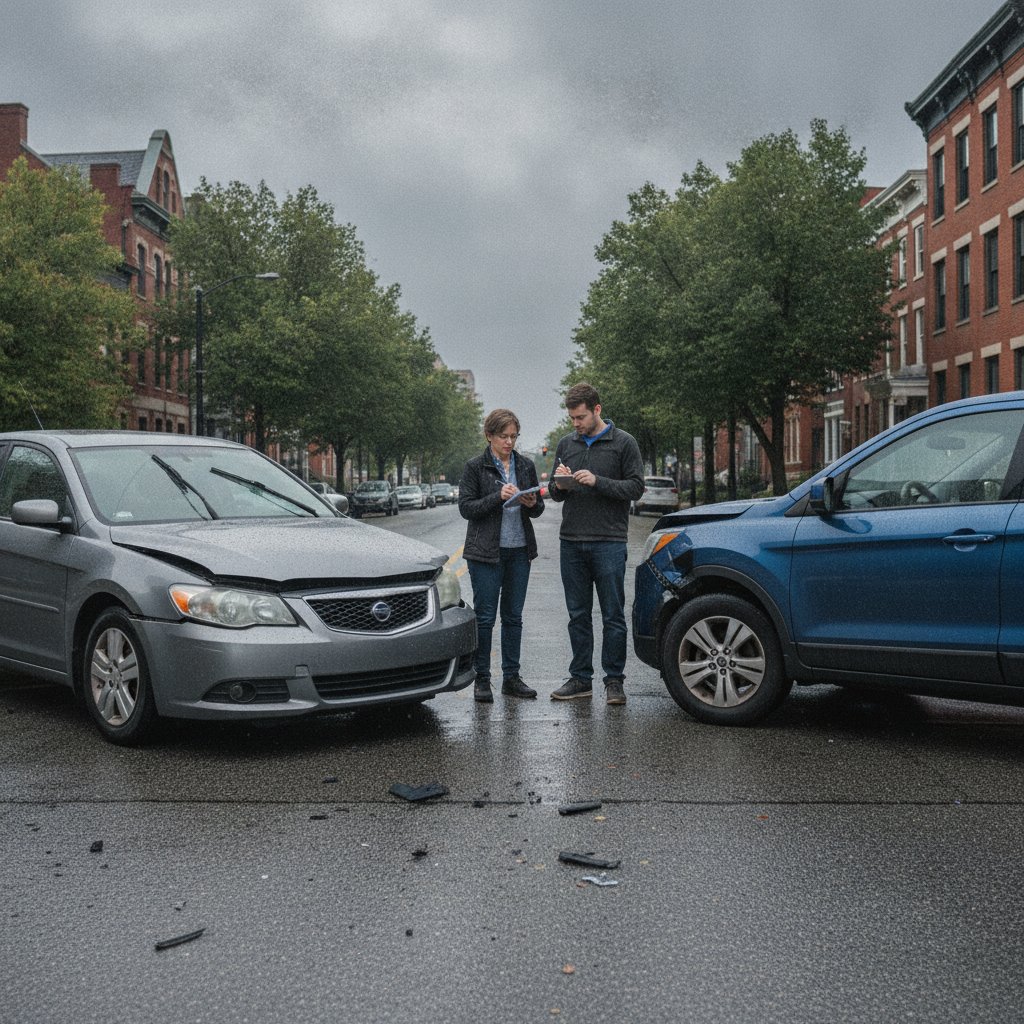
Comparative Fault · Louisville, KY
Kentucky Pure Comparative Fault: What It Means for Louisville Injury Claims
How Kentucky’s pure comparative fault rule (KRS 411.182) works after a Louisville crash or fall. Shared blame may reduce your recovery, not erase it.
01 · The short answer
Comparative Fault in plain English.
If you are partially at fault for an accident in Louisville, you can still recover money for your injuries. Kentucky’s pure comparative fault system reduces your compensation by your percentage of fault, but it does not completely bar you from recovery, even if you were more than 50% to blame. The final allocation of fault depends on the specific facts of your case.
Pure Comparative Fault: Pure comparative fault is a legal rule where an injured person can recover damages even if they are partially to blame for the incident. Their total compensation is simply reduced by their assigned percentage of fault, with no cutoff point.
Updated October 14, 2026. Kentucky law.

02 · Comparative Fault guide
What is Pure Comparative Fault in Kentucky?

When you are hurt in an accident, one of the first things an insurance company considers is who was at fault. In Kentucky, the law recognizes that sometimes, more than one person is to blame. The legal doctrine that governs these situations is called pure comparative fault, codified in Kentucky Revised Statute § 411.182.
This statute instructs courts and juries to determine two key things: the total damages a claimant suffered, and the percentage of fault belonging to each party involved. Your final recovery is your total damages minus an amount equal to your percentage of fault. For example, if your total damages are $100,000 and a jury finds you 20% at fault, your recoverable damages would be $80,000. The "pure" aspect of Kentucky's rule is crucial: you can recover damages even if you are found 51% or even 99% at fault. Your recovery is reduced, not eliminated. This is a major difference from many other states that use a "modified" comparative fault system, which bars you from recovering anything if your fault exceeds 50% or 51%.
Understanding this rule is vital because insurance adjusters often use fault allocation as a primary tool to reduce settlement offers. They may try to convince you that because you share some blame, your claim is worthless. In Kentucky, that is not the case. The law ensures that at-fault parties are held responsible for the portion of the harm they caused.
How Kentucky's Rule Compares to Other Systems
To understand how favorable Kentucky's rule can be for injured people, it helps to see it side by side with the systems used in other states.
| Fault System | How It Works | Example: $100,000 in Damages, You are 60% at Fault |
|---|---|---|
| Pure Comparative Fault (Kentucky) | You can recover damages no matter your percentage of fault. Your recovery is reduced by your fault percentage. | You can recover $40,000 (your $100,000 damages reduced by your 60% fault). |
| Modified Comparative Fault (51% Bar) | You can recover reduced damages only if your fault is 50% or less. If you are 51% or more at fault, you recover nothing. | You recover $0, because your 60% fault is over the 50% limit. |
| Contributory Negligence (Few States) | If you are found to be even 1% at fault, you are completely barred from recovering any damages. | You recover $0, because you were partially at fault. |
03 · Comparative Fault guide
How Does Shared Fault Affect a Louisville Injury Settlement?

In any Louisville personal injury claim, from a car wreck on the Watterson Expressway to a slip and fall at a Shively retail store, the concept of fault is a central point of negotiation. Insurance adjusters are trained to look for any action you took, or failed to take, that could shift a percentage of blame onto you. This is a core part of the defense playbook. Every percentage point of fault assigned to you directly reduces the value of your claim.
For instance, an adjuster might review a police report from a T-bone crash on Dixie Highway and argue that you were 25% at fault for not reacting quickly enough, even if the other driver ran a red light. In a premises liability case, they might claim you were 50% at fault for looking at your phone when you slipped on a wet floor. These initial percentages are not legal rulings; they are opening offers in a negotiation. The goal is to make you feel responsible and convince you to accept a lower settlement.
A key part of the case-building process is to counter these tactics with evidence. This involves:
The outcome of your case depends on its specific facts. However, understanding that an allegation of shared fault is the beginning of a conversation, not the end, is critical. The final percentage is not fixed until you agree to a settlement or a jury decides it.
- 01
Challenging the Narrative
We don't accept the adjuster's story. We conduct an independent investigation to establish the facts that show the other party's negligence.
- 02
Gathering Proof
This includes securing surveillance video, finding and interviewing witnesses, and sometimes hiring accident reconstruction experts to prove what really happened.
- 03
Framing the Argument
We build a case that minimizes your percentage of fault under the law. Our experience provides insight into how carriers value claims and where their arguments are weakest.
04 · Step by step
What Types of Louisville Injury Cases Involve Shared Fault Arguments?

Arguments over comparative fault can arise in almost any personal injury case. Insurance companies frequently raise them in specific scenarios where they believe they can successfully shift blame to the injured party. Here are some common examples in the Louisville area where these disputes are prevalent.
- 01
Automobile and Truck Accidents
In crashes on busy roads like I-264 or I-65, fault can be complex. An insurer might argue you were partially at fault for speeding, making a sudden lane change, or not using a turn signal, even if their insured driver was the primary cause. In tractor-trailer wrecks, the defense may try to blame the smaller vehicle's driver for being in a blind spot or cutting off the truck. Preserving evidence from the scene and the truck's electronic data is crucial to fighting these claims.
- 02
Premises Liability (Slip and Fall)
In slip-and-fall cases, property owners almost always argue the victim shares the blame. They will claim the hazard was "open and obvious" and that you should have seen and avoided it. They might argue you were distracted or wearing inappropriate footwear. However, Kentucky law places a strong duty on property owners to keep their premises safe, and these defenses have limits.
- 03
Motorcycle Accidents
A strong bias often exists against motorcycle riders. Insurance adjusters and juries may assume the rider was speeding or driving recklessly, even with no evidence. They will question whether the rider took appropriate safety measures. Countering this bias requires a thorough investigation focused on the other driver's actions, such as failing to yield during a left turn, which is a very common cause of motorcycle crashes.
- 04
Workplace Injuries with Third-Party Claims
While you generally cannot sue your employer for a workplace injury, you can sue a negligent third party. For example, a union electrician working on a construction site who is injured by a different subcontractor's employee can file a personal injury lawsuit against that subcontractor. In these cases, the defense will often try to assign fault among your employer, the third party, and you to reduce their client's financial responsibility.
05 · Comparative Fault guide
How Do You Prove Another Party Was More at Fault?

Successfully navigating a comparative fault argument depends entirely on the quality of your evidence. The more objective proof you have, the harder it is for an insurance company to assign an unfairly high percentage of fault to you. While every case is different, certain types of evidence are consistently powerful in establishing liability.
Key evidence in a shared fault case often includes:
- Police and Incident Reports: While not the final word, a favorable police report provides a strong starting point. It contains the responding officer's initial assessment, witness information, and sometimes a diagram of the scene.
- Witness Statements: Independent witnesses who have no stake in the outcome can be very persuasive. It is vital to get their contact information at the scene, as a neutral third-party account can dismantle the other driver's self-serving story.
- Photos and Videos: Visual evidence is compelling. This includes photos of vehicle damage, skid marks, the hazardous condition that caused a fall, and any visible injuries. Surveillance footage from nearby businesses or dashcam video can be definitive proof.
- Electronic Data: In commercial truck accidents, the truck's Electronic Logging Device (ELD) and dashcam are critical. A spoliation letter must be sent immediately to the trucking company to ensure this data is not destroyed.
- Expert Opinions: In complex cases, an accident reconstructionist can analyze physical evidence to determine speeds, points of impact, and the sequence of events. Medical experts can connect your injuries directly to the incident, refuting claims that they were pre-existing.
We move quickly to preserve this evidence before it disappears. Building a strong, evidence-based case is the most effective strategy to minimize your assigned percentage of fault and protect the full value of your claim. The outcome of any case depends on the facts and evidence available. This content is for informational purposes and does not constitute legal advice.
06 · Common questions
Comparative Fault -
straight answers.
What if the police report says I was partially at fault?
A police report is an officer's opinion based on limited evidence at the scene; it is not the final word on legal fault. We often investigate further to uncover facts and witness testimony that can present a more accurate picture of what happened and challenge the report's conclusions.
This is general information, not legal advice.
Can I still recover damages if I wasn't wearing a seatbelt in a car accident?
Kentucky has specific laws regarding seatbelt use and its effect on injury claims. While failure to wear a seatbelt can be a factor, it does not automatically prevent you from recovering damages. The defense must prove that your failure to wear a seatbelt caused or worsened your specific injuries.
This is general information, not legal advice.
Does Kentucky's comparative fault rule apply to dog bite cases?
Kentucky has a strict liability statute for dog bites (KRS 258.235), meaning the owner is liable for damages regardless of the dog's history. While a defense of provocation might be raised, the comparative fault analysis is different than in a standard negligence case like a car accident.
This is general information, not legal advice.
What is the difference between 'comparative fault' and 'contributory negligence'?
Kentucky uses pure comparative fault, where your recovery is reduced by your fault percentage. A few states use contributory negligence, a much harsher rule where you are barred from recovering any money if you are found even 1% at fault.
This is general information, not legal advice.
How long do I have to file an injury claim in Kentucky if fault is disputed?
Arguments about fault do not change the filing deadline. For most Kentucky personal injury cases, the statute of limitations is only one year from the date of the injury. It is critical to contact an attorney well before this deadline expires to protect your rights.
This is general information, not legal advice.
Will a comparative fault argument make my case take longer to resolve?
Disputes over liability can sometimes extend the negotiation phase of a case. However, by building a strong case with compelling evidence from the start, we can often overcome these disputes efficiently and push for a fair settlement without unnecessary delays.
This is general information, not legal advice.
Don’t see your question? More on the FAQ page, or just ask us directly.
Free case review
Still have questions? Ask a lawyer.
Tell us what happened. We will explain where you stand, what deadlines apply and what your claim may be worth. No fee unless we win.
Educational only, not legal advice. Reading this page does not create an attorney-client relationship. Kentucky deadlines and rules depend on your facts. Contact a licensed Kentucky attorney about your situation.
Comparative Fault · Louisville, KY
Hurt and not sure what’s next?
Let's start the file.
Free case review, no fee unless we win. Our fee starts at 25%. Same-day callback from our team.