

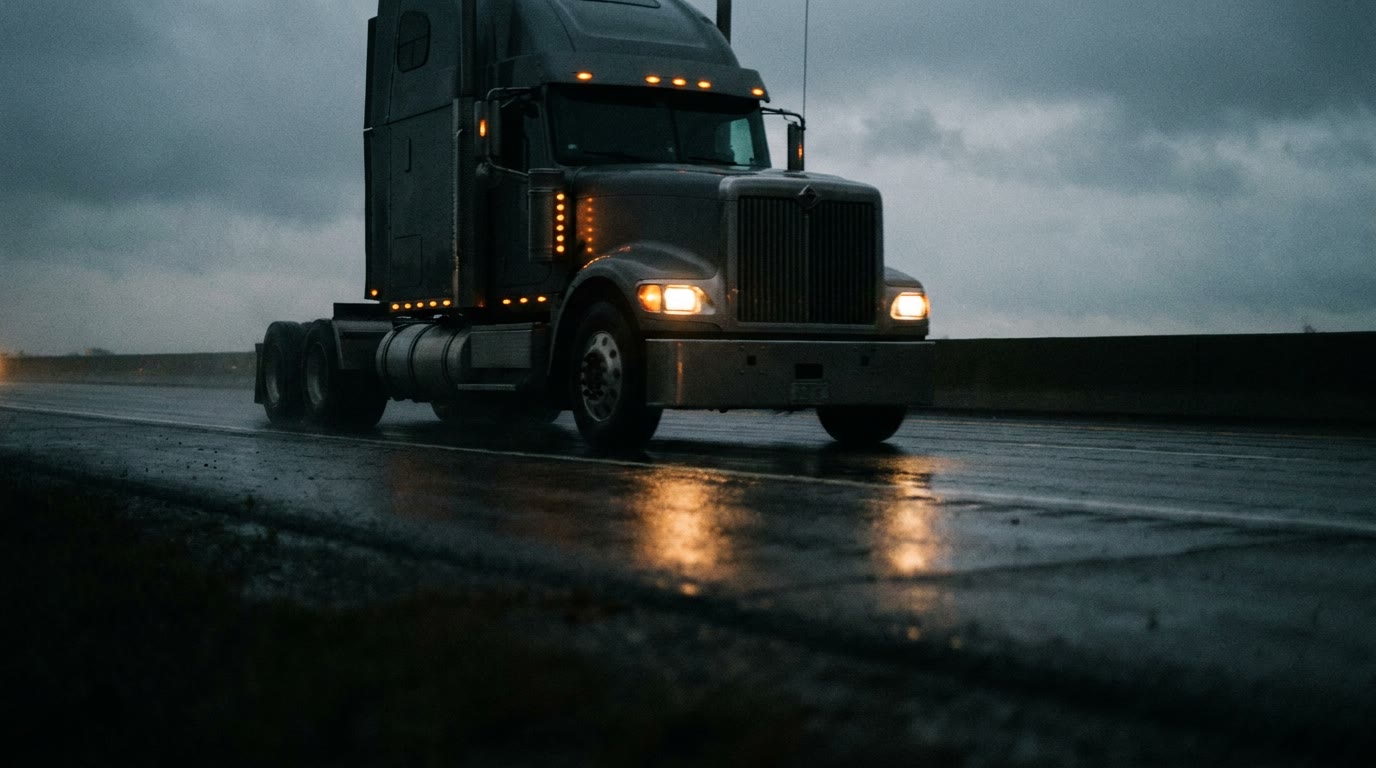
Tractor trailer accidents · Kentucky
When the truck is the size of your house,
the defense team is too.
Commercial trucking is its own world - federal regulations, electronic logs, professional defense counsel deployed within hours of impact. If you've been hit by an 18-wheeler, you're not in a routine auto case. You're in a federal-rules case with a corporate defendant. We treat it that way from hour one.
01 · The problem
By the time you're released from the ER,
the trucking company's investigators are already on scene.
Commercial motor-carrier policies have rapid-response protocols. Within hours of a serious crash, the trucking company dispatches an adjuster, a defense attorney, and frequently an accident reconstructionist to the scene. Evidence - skid marks, debris, dashcam footage, electronic logging device (ELD) data - starts disappearing immediately.
Meanwhile you're in a trauma bay. Your phone is locked in a hospital drawer. Nobody is preserving anything on your behalf. That asymmetry is the entire game.
We move the same day. A spoliation letter goes to the carrier and the driver's employer within 24 hours, formally putting them on notice that destroying evidence creates a separate cause of action. Investigators get out to the scene. We get the ELD data, the driver's CDL history, the carrier's safety record. The federal Motor Carrier Safety Regulations are the toolkit - and we know them.

02 · Defense playbook, decoded
What the carrier does.
What we do back.
- Their tacticRapid-response defense team on scene
- Our counterSpoliation letter inside 24 hours. Independent reconstructionist deployed. Photo + measurement record preserved before the road is back to normal.
- Their tacticELD / dashcam data “unavailable”
- Our counterFederal preservation duty is triggered the moment they're on notice. We document the request in writing and litigate the destruction if it disappears.
- Their tacticDriver scapegoated, carrier insulated
- Our counterWe sue the carrier directly - negligent hiring, negligent training, negligent retention. The driver is the symptom; the carrier's safety record is the case.
- Their tacticMulti-policy coverage hidden
- Our counterCommercial fleets often have a primary policy, an MCS-90 endorsement, and excess layers. We dig until we find the full coverage tower - not just the first $1M.
03 · How we handle it
Step by step.
No mystery, no padding.
- 01
Same-day intake + spoliation letter.
Within 24 hours of being retained, formal notice goes to the carrier preserving every piece of physical and electronic evidence.
- 02
Independent investigation.
Our own reconstructionist, scene photos, witness canvass, surveillance pull from nearby businesses if applicable.
- 03
Federal compliance review.
FMCSA records, ELD logs, hours-of-service compliance, driver qualification file, drug-and-alcohol testing history, maintenance records.
- 04
Medical + economic damages.
Trucking cases produce serious injuries - life-care planners, vocational experts, economists get retained early for catastrophic files.
- 05
Litigation.
Carriers settle pre-suit on small trucking cases. Real money cases get filed. We're ready for the courtroom from day one.
- 06
Trial / verdict.
Catastrophic trucking cases that reach trial often produce verdicts well above policy. The threat of that drives most settlements.
04 · Where it shows up
Tractor Trailer Accidents -
six common shapes.
Trucking is not auto with a bigger vehicle. Different rules, different defendants, different damages.
- 01
Rear-end by 18-wheeler
Often catastrophic. Driver fatigue, distraction, or following distance are the usual root causes.
- 02
Underride collisions
A car slides under the trailer. Federal regulations on side and rear guards are increasingly the issue.
- 03
Jackknife / loss of control
Weather is rarely a defense - driver speed and load securement usually are the cause.
- 04
Cargo / load failure
Shifting loads, falling cargo. Liability can run against the shipper or loader, not just the carrier.
- 05
Wrong-way / wrong-route
Routing software, dispatch pressure, or driver error. We pull dispatch records.
- 06
Box truck / commercial van
Smaller commercial vehicles trigger many of the same federal rules - and the same case-building approach.
05 · A case we’ve handled
One file.
Real outcome.
$1.8M
Tractor Trailer Accidents
Policy limits recovered for a family after a rear-end collision on I-65 near the Spaghetti Junction.
Past results do not guarantee a similar outcome. Every case is evaluated on its own facts.
06 · Common questions
Tractor Trailer Accidents -
straight answers.
Why is a trucking case different from a regular auto case?
Federal regulations (FMCSA), commercial policy limits typically 10–100× higher than passenger auto, professional defense counsel on the case within hours, and electronic data sources that don't exist in passenger cases. The case-building is fundamentally different.
What evidence disappears fastest?
ELD (electronic logging device) data, dashcam footage, dispatch records, and the truck itself if it gets back into service. Spoliation letters need to go out within hours, not weeks.
Who pays - the driver or the trucking company?
Almost always the carrier and its insurer, through respondeat superior. Direct claims against the carrier (negligent hiring, training, retention) can also unlock excess coverage layers.
What if I was partially at fault?
Kentucky's pure comparative fault rule lets you recover even if you share blame. Trucking cases are also more likely to involve federal preemption arguments that the carrier will try to use - we know how to beat them.
Don’t see your question? More on the FAQ page, or just ask us directly.

Tractor trailer accidents · Kentucky
Hit by a semi?
Move today, not next week.
Evidence disappears in trucking cases faster than any other practice area. Even if you're not ready to retain - a 20-minute call now protects your file.